U.S. Consumers Pivot to Hybrids as EV Growth Cools

Overview — Recent market data from late 2025 shows a noticeable change in U.S. buyer behavior. Although sales of fully electric vehicles (EVs) continue to rise year-over-year in many segments, overall EV growth has moderated compared with the rapid gains of previous years. Meanwhile, conventional hybrids and plug-in hybrids are gaining share as consumers look for fuel economy without some of the perceived trade-offs of pure battery-electric ownership.
:contentReference[oaicite:0]{index=0}What the data says
Industry trackers reported that while EV unit sales remain higher than in past years, the rate of growth slowed in 2024–2025 compared with earlier jumps seen in 2022–2023. Government and industry datasets show that the combined share of hybrid, battery-electric and plug-in hybrid vehicles climbed (roughly ~22% of light-duty sales in early 2025 in one estimate), with hybrid electrified powertrains expanding their slice of that total. This reflects a steady, measurable uptick in hybrid models' market penetration across several segments: compact cars, crossovers and mid-size SUVs.
:contentReference[oaicite:1]{index=1}Why consumers are choosing hybrids
- Fuel cost sensitivity: Elevated gasoline prices make the immediate, everyday savings from hybrids attractive to buyers who are cost-conscious.
- Charging infrastructure concerns: Many shoppers cite limited public fast-charging availability and longer rural charging gaps as reasons to avoid full EVs.
- Upfront price and resale worries: Despite incentives, higher purchase prices for many EV models and uncertainty about long-term battery life affect decisions.
- Practical compromise: Hybrids provide improved efficiency without the need to change driving habits or rely on public charging networks.
Automakers respond: more hybrids in the pipeline
Major automakers are adjusting production and product strategies. Some European and Asian groups have delayed or rebalanced portions of their electric-only rollouts, instead extending hybrid offerings and revising launch plans for certain models to include hybrid variants. At the same time, a number of OEMs — including legacy sellers with long hybrid histories — reported strong hybrid sales during 2025 and announced plans to broaden hybrid availability in North America.
:contentReference[oaicite:2]{index=2}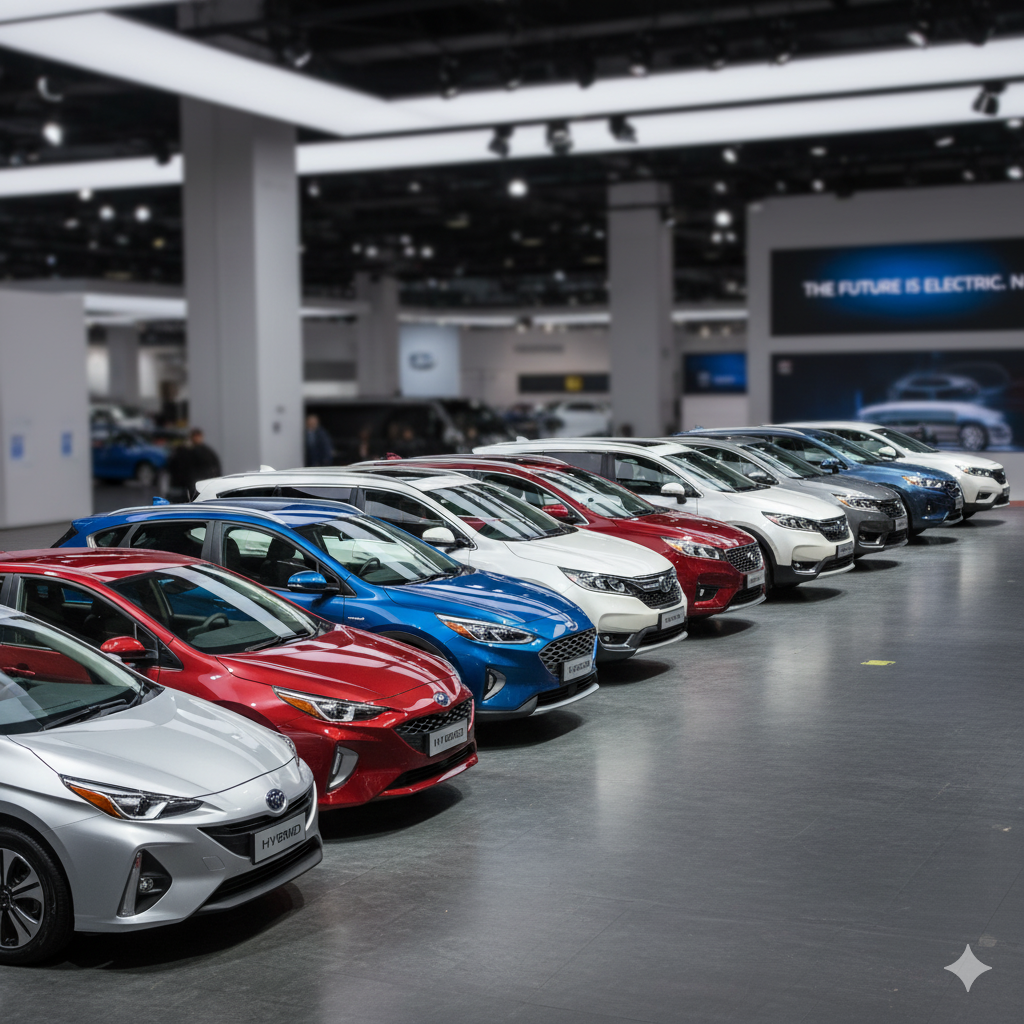
Examples & numbers (recent data)
Specific sales releases and market reports from 2025 show: automakers reporting larger-than-expected electrified (hybrid + EV) volumes in several months, with hybrids contributing strongly to those totals. For instance, some manufacturers reported double-digit percentage increases in hybrid registrations year-over-year in mid-2025, while EV growth rates varied widely by brand and model.
:contentReference[oaicite:3]{index=3}Policy, incentives and infrastructure
Policymakers and incentives remain an important factor. National and state incentives that encourage EV uptake have helped the overall electrified category, but changes to subsidy programs, the pace of charging infrastructure rollout, and trade/tariff pressures on supply chains have created uncertainty. Industry analysts warn that policy shifts or subsidy changes can materially affect how fast consumers move toward pure EVs versus hybrids.
:contentReference[oaicite:4]{index=4}What analysts are saying
“We’re seeing a rebalancing: EVs are still growing but at a slower pace than earlier forecasts predicted; hybrids present an attractive, lower-friction option for many buyers,” said market analysts tracking vehicle mix and consumer behavior in 2025.
Investment banks and market research groups updated their long-term EV penetration forecasts in 2025 to reflect slower-than-expected uptake in some markets and a larger role for hybrids in the medium term.
:contentReference[oaicite:5]{index=5}Consumer advice — buying a hybrid vs an EV
If you’re considering a new car, ask yourself:
- How many miles do you drive daily? (If mostly short trips, a hybrid may give excellent real-world economy.)
- Do you have reliable access to home charging? (If yes, EVs become more attractive.)
- What resale and maintenance expectations do you have in 3–5 years? (Hybrids often have well-established service networks and predictable resale patterns.)
Outlook
Through the remainder of 2025 and into the next few years, analysts expect a mixed landscape: EV adoption will continue, especially where incentives, charging infrastructure, and lower-cost EV models align — but hybrids are likely to retain or grow share in regions and buyer segments where immediate cost or infrastructure concerns dominate. Automakers will likely keep both strategies in play: advancing EV programs while investing in hybrid variants to capture a broader set of customers.
:contentReference[oaicite:6]{index=6}
Reporter: Auto Specialist Advice
Sources: International Energy Agency (IEA), U.S. Energy Information Administration (EIA), Goldman Sachs research, Reuters coverage of OEM strategy, automaker sales releases (Toyota, Ford), Cox Automotive market data.
:contentReference[oaicite:7]{index=7}